










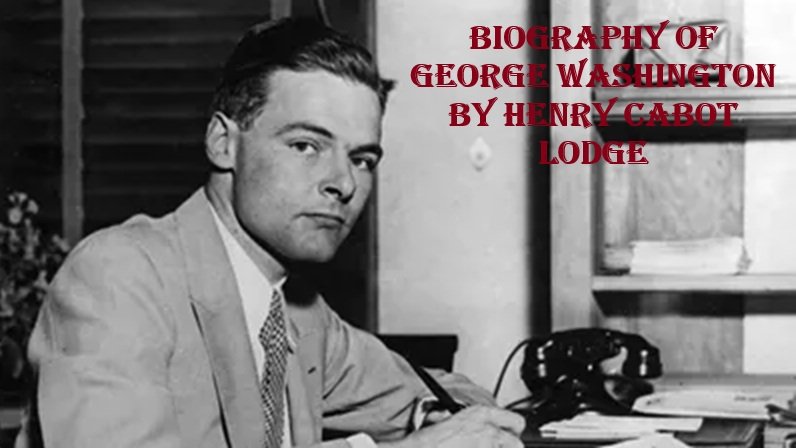
Introduction: Biography of George Washington by Henry Cabot Lodge
George Washington’s effect on victory and shaping the U.S. Constitution makes him one of the most studied figures in records. Biography of George Washington by Henry Cabot Lodge.
However, not all biographies are created the same. Among the most acclaimed historic biographies is the only one written by Henry Cabot Lodge, a U.S. senator and historian known for his meticulous studies and eloquent writing style.
Henry Cabot Lodge—The Biographer
Henry Cabot Lodge (1850–1924) turned out to be an incredible American statesman, historian, and baby-kisser. A graduate of Harvard University, Lodge served in the U.S. Congress and has become a noted authority on diplomatic records.
Lodge’s biography of George Washington is renowned for:
- Its reliance on unique supply material
- Analytical clarity and interpretive notion
- Historic contextualization that connects Washington to early American constitutionalism
Lodge introduced both a politician’s notion and a historian’s region to his paintings.
Overview of the Biography
Unlike shorter or more narrative biographies, Lodge’s artwork offers:
Deep chronological exploration
Contextual assessment of events
Washington’s non-public letters and speeches
Examination of political philosophy
Interpretation of Washington’s management picks
Lodge installed the biography not actually as an existence tale, but as a replicate of the rising American republic, characterizing Washington as both consultant and supervisor.
Table: Key Features of Lodge’s Biography
| Aspect | Description |
|---|---|
| Author | Henry Cabot Lodge |
| Focus | Life, leadership, and legacy of George Washington |
| Research Style | Primary documents, letters, speeches, contextual history |
| Narrative Style | Analytical, chronological, thematic |
| Audience | Scholars, students, history readers |
| Publication Era | Early 20th Century |
| Key Contribution | Connects Washington to nation-building and constitutional ideas |
Washington’s Early Life
George Washington turned out to be born on February 22, 1732, in Westmoreland County, Virginia. His early years have been authentic with the resources of the agricultural Virginia society, the colonial setup order, and the British imperial presence.
His mother and father:
- Augustine Washington (father)
- Mary Ball Washington (mother)
Early Education and Influences
Washington did not attend college within the present-day feel; however, his training covered:
- Mathematics and surveying
- Military fundamentals
- Field studies and geography
This practical education organized him for his early career as a surveyor—a profession that might define Washington’s familiarity with the land and frontier management.
Military Leadership in the Revolutionary War
joy, but quickly, Washington’s strategic management in the Continental Army is one of all his defining achievements. His navy profession started out with restrained formal joy but quickly evolved into expert command.
Key Battles
- Battle of Boston (1775–1776)
- Battle of Trenton (1776)
- Battle of Saratoga (1777)
- Valley Forge (1777–1778)
- Siege of Yorktown (1781)
Washington’s control turned out to be not honestly tactical but profoundly motivational, uniting militia bands into disciplined regiments and guiding them towards skilled British forces.
Presidency and Political Vision
George Washington served phrases due to the fact that he was the primary president of the USA from 1789 to 1797.
Key Presidential Actions
- Establishment of the Cabinet machine
- Creation of the First Bank of the united states
- Establishing neutrality in overseas wars
- Creating precedents for presidential behavior
Washington manages common authorities and the stability among states and federal governance.
Washington’s Retirement and Legacy
After two terms, Washington voluntarily relinquished power—a groundbreaking act that solidified democratic norms.
His retirement at Mount Vernon remains one of the extremely good symbolic moments in American history.
Themes and Interpretation in Lodge’s Biography
Lodge focused on subject subjects, which include:
Leadership through restraint
Republican values vs monarchy
Washington’s moral uprightness
Political innovation
Lodge painted Washington not as an army hero, but as a thinker who balanced strength with extraordinary civic features.
Washington Compared: Lodge vs Other Biographers
While many historians have written approximately Washington, Lodge’s paintings stand proud due to the fact:
Emphasis on number one property
Analytical in desire for basically narrative style
Connects Washington’s decisions to broader political philosophy
Impact on Modern America
Washington’s control and Lodge’s interpretation helped define later political and constitutional discussions. His presidency installation norms notwithstanding, the truth is applicable these days.
Interestingly, his emphasis on management and countrywide routes can be paralleled with present-day organizational systems—including financial institutions like real estate investment trusts (REITs).
Related Modern Topic: How Many Jobs Are Available in Real Estate Investment Trusts
Although it would seem unrelated, know-how the financial gadget and artwork structures relate all over again to Washington’s foundational economic governance standards. Washington believed in fostering financial infrastructure—a principle that applies even to 21st-century establishments like real estate investment trusts.
What Are Real Estate Investment Trusts (REITs)?
REITs are companies that own, feature, or finance profit-generating real property. They allow purchasers to invest without direct property possession.
Jobs in REITs
These encompass careers in:
- Property control
- Investment assessment
- Asset acquisition
- Marketing/transitions
- Finance and compliance
Table: Leading Types of Jobs in REITs
| Job Category | Description | Average Skills |
|---|---|---|
| Property Manager | Oversees day-to-day operations | Real estate management |
| Financial Analyst | Portfolio analysis & investment strategy | Finance or accounting |
| Asset Manager | Maximizes the return of property assets | Strategic planning |
| Compliance Officer | Ensures legal & regulatory compliance | Legal or financial expertise |
| Marketing Specialist | Promotes properties and investor relations | Communications/marketing |
How Many Jobs Are Available in REITs?
There isn’t a difficult and speedy worldwide quantity because REIT employment fluctuates for the duration of areas and sectors, but contemporary company reviews estimate:
2024 estimate: ~1 million+ direct jobs in REIT-related sectors inside the U.S.
(Exact numbers may additionally additionally vary by way of source and vicinity.)
Conclusion
The Biography of George Washington by Henry Cabot Lodge isn’t merely a historic account—it’s an intellectual bridge connecting the founding standards of the United States to ongoing dialogue about governance, economics, and management.
From Washington’s youngsters as a surveyor to his presidency, Lodge’s biography exhibits the scale of a leader whose effect keeps forming American notions and establishments—from democracy to modern employment systems like REITs.
Frequently Asked Questions
Q1: Why is Henry Cabot Lodge’s biography of Washington taken into consideration as huge?
A: It combines primary property with analytical historic interpretation.
Q2: What became Washington’s most important contribution to the U.S.?
A: Establishing the constitutional framework and executive function of the presidency.
Q3: How many jobs are available in actual belongings funding trusts?
A: There are approximately more than 1 million jobs related to REITs within the U.S. On my personal (scenario to community monetary changes).
Q4: Did Washington have better formal schooling?
A: No—his schooling has emerged as sensible, specializing in surveying and management.
Q5: What instructions from Washington’s control look at in recent times?
A: Principles of restraint, imaginative and prescient, civic duty, and economic basis.