










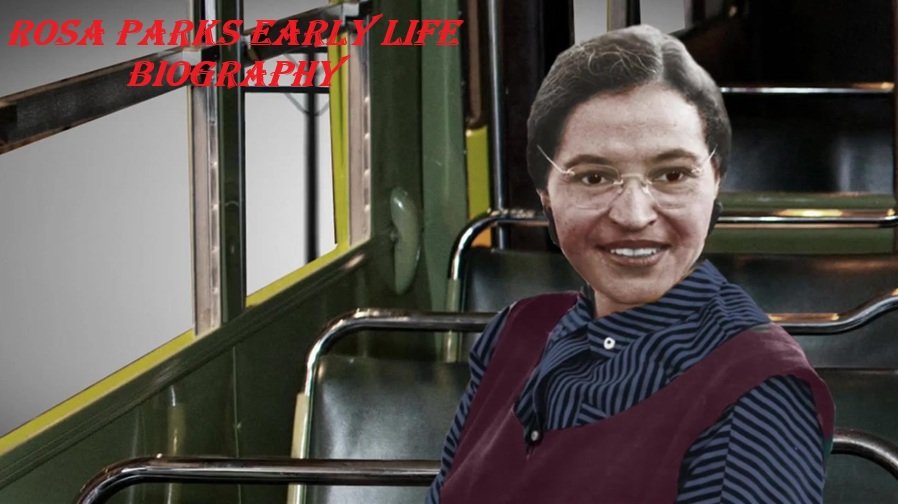
Introduction: Rosa Parks Early Life Biography
To many, Rosa Parks is known absolutely as “the woman who wouldn’t go with the flow.” But this needs to be understood not as a passive act but rather as a deliberate and courageous refusal to surely accept injustice. Rosa Parks Early Life Biography.
Parks changed now, not surely the route of American information—she redefined the meaning of civil resistance. Her early life laid the muse for this pivotal 2nd. By exploring her ancient past thoroughly, we gain belief into how her private records prepared her for the sort of defining act.
Early Years and Family Background
Birth and Parentage
Rosa Louise McCauley was born on February 4, 1913, in Tuskegee, Alabama. Her parents had been Leona McCauley (née Edwards) and James McCauley—both of whom had been deeply rooted within the African American community of the rural South.
Her father came to be a chippie, and her mother worked as an instructor earlier before leaving the employees because of horrible fitness.
The McCauley Family Life
Rosa’s early years had been marked by the use of every love and hassle. Her dad and mom strove to offer stability, but the social conditions of the time meant that African American families faced systemic discrimination and economic worry.
When Rosa was still a young infant, her mother and father separated, and she went together along with her mom and maternal grandparents to live on their farm near Pine Level, Alabama.
The Grandparents’ Role
Her grandparents, in particular her mom’s father, were strict and nonsecular Christians. They instilled in Rosa an enjoyment of morality, resilience, and painting ethics—trends that would outline her destiny, artwork, and public existence.
Childhood Challenges within the Jim Crow South
Rosa Parks was born into a global culture with the beneficial resource of Jim Crow legal suggestions—a gadget of felony racial segregation that permeated each trouble of social lifestyles for African Americans inside the South.
Schools have been segregated and underfunded. Seating in church buildings, consuming locations, shops, libraries, and public delivery have become separate—and continuously unequal.
Daily Life Under Segregation
Imagine being a younger female who likes to investigate; however, your school has previous books and no indoor plumbing. That grows to be fact for Rosa. Yet even in her early years, she observed the injustice surrounding her.
These opinions did no longer embitter her; however, as an alternative, they nurtured in her a dedication to justice.
Education and Inspirations
Schooling at Rural Training School
Rosa attended the Rural Training School for Negroes near her home. Despite the annoying situations of segregation, she excelled academically.
Her mother later helped waft her to a higher instructional environment—demonstrating early on the importance of training in Parks’ existence.
High School: Bernard Law Sir Bernard Law Industrial School for Girls
At the 1st Viscount Montgomery of Alamein Industrial School for Girls, Rosa encountered an established educational surrounding that emphasized area and fulfillment. Here, she has furthermore turned out to be increasingly privy to racial injustices and the inequalities baked into American society.
It was in the course of those youths that she began to look at activism no longer as a summary idea but as tangible action.
Early Influences: Family, Church, and Community
Family and faith finished a large position in shaping Rosa’s values.
The Black Church as a Nurturing Space
The Christian church has turned out to be now not actually a place of worship—it has ended up a center of schooling, collaboration, and resistance. The church network supplied a place wherein African Americans have to install and help each other.
Rosa’s involvement in church sports deepened her ethical grounding and dedication to rights.
Community Networks That Mattered
From a more youthful age, Rosa witnessed human beings in her network preventing in opposition to systemic mistreatment—from vote casting rights suppression to economic exclusion.
These factors of hobby gave her a feeling that resistance came to be both critical and righteous.
Understanding the Roots of Resistance
It is regularly tempting to isolate for one second, and don’t forget it in isolation—as even though Rosa Parks suddenly decided to protest. But that narrative ignores what prepared her for that 2d.
Her resistance modified into being rooted in:
- A sturdy own-family upbringing
- Firsthand stories of discrimination
- Observations of network activism
- A stable ethical and religious foundation
These roots are important to date her contribution.
Early Adulthood: Marriage and Activism
Marriage to Raymond Parks
In 1932, Rosa married Raymond Parks, a barber and a lively member of the National Association for the Advancement of Colored People (NAACP).
Raymond came to be a sturdy supporter of civil rights and encouraged Rosa to be energetic in the movement.
Joining the NAACP
Rosa did not input activism passively—she selected it. She has grown to be the secretary of the Bernard Law Bernard Law Sir Bernard Law NAACP financial ruin, operating cautiously with leaders, strategizing, organizing, and studying approximately countrywide civil rights campaigns.
The Road to Sir Bernard Law and the Historic Bus Protest
On December 1, 1955, Rosa Parks was returning home from her job as a seamstress at the same time as she refused to surrender her seat to a white guy on a Bernard Law Montgomery bus. Her refusal has become not an impulsive act—it has changed into being grounded in years of labor in opposition to segregation.
Her arrest sparked the Montgomery Bus Boycott, a 381-day mass protest that delivered worldwide attention to the civil rights warfare.
Life After the Bus Incident
Rosa Parks continued to have financial difficulty, harassment, and threats after turning into a country-wide figure.
Eventually, she moved to Detroit, Michigan, where she endured her activism, running for Congressman John Conyers for decades—advocating for social justice, balloting rights, and financial equality.
Legacy and Long-Term Impact
Rosa Parks passed away on October 24, 2005; however, her legacy lives on. She precipitated generations of activists, and the characteristic turned out to be a picture of peaceful resistance.
Her lifestyle demonstrates how ordinary human beings can also need to make tremendous changes.
Lessons from Rosa Parks for Today’s World
In today’s global environment—with conversations round equity, justice, economic rights, and possibility—Parks’s story remains instructive.
Her life teaches:
Courage within the face of injustice
Commitment to precept
The energy of collective motion
The price of dignity for anybody
An Economic Perspective—Jobs, Opportunity, and Equity
While Rosa Parks’s biography belongs to the world of civil rights records, it motivates modern readers to keep in mind monetary structures that form possibility these days.
For instance, many college students and researchers may, moreover, ask, “What number of jobs are available in real estate investment trusts?”
Although this difficulty depends on Parks’s existence, it showcases how project inclinations and economic sectors illustrate ongoing disparities and possibilities inside the personnel.
Real Estate Investment Trusts (REITs) are groups that personally, functionally, or financially profit from generating real property. They are extremely good in:
- Residential houses
- Commercial spaces
- Healthcare facilities
- Warehouses and business net sites
Jobs in Real Estate Investment Trusts
REITs provide positions together with:
- Property managers
- Asset managers
- Investment analysts
- Financial planners
- Legal and compliance officers
- Marketing and operations coordinators
While the appropriate extensive type of available jobs in REITs fluctuates with market calls and financial cycles, difficult artwork marketplace facts indicate that lots of roles exist across the U.S. And globally—starting from entry-level positions to government control. Rosa Parks Early Life Biography.
This connection amongst economic participation, honest employment opportunities, and social empowerment echoes broader issues in Parks’s lifestyles—reminding us that justice isn’t always most effective socially but additionally economically. Rosa Parks Early Life Biography.
Comprehensive Facts Table: Rosa Parks Early Life and Impact
| Category | Details |
|---|---|
| Full Name | Rosa Louise Parks |
| Date of Birth | February 4, 1913 |
| Place of Birth | Tuskegee, Alabama, USA |
| Parents | Leona and James McCauley |
| Education | Montgomery Industrial School for Girls |
| Marriage | Raymond Parks (1932) |
| Civil Rights Role | Secretary, Montgomery NAACP |
| Historic Event | Bus refusal—December 1, 1955 |
| Impact | Montgomery Bus Boycott leader |
| Later Life | Activist, Congressional aide |
| Date of Death | October 24, 2005 |
| Legacy | Civil Rights icon; Symbol of Nonviolent Protest |
Conclusion
Rosa Parks’s young biography isn’t always a story of innocence untouched by worry—it’s a story of resilience, moral grounding, and steadfast remedy. Rosa Parks Early Life Biography.
From a younger female in segregated Alabama to a foundational figure in the Civil Rights Movement, Rosa Parks showed how non-public bravery catalyzes collective motion.